Learn professional-grade web application development with Ruby on Rails
Ruby on Rails (Rails 8) Application Development 03

Get Started Now!
Course Subscriptions
Course
Full online version of the tutorial, embedded streaming videos for all sections, exercises with editable answers, progress tracking, and membership in the Learn Enough Society (community exercise answers, private chat group). Pause your subscription at any time!


What’s Learn Enough?
Learn Enough is a tech education company founded by Michael Hartl, Lee Donahoe, and Nick Merwin to teach essential technical skills for the 21st century. Learn Enough offers ebooks, videos, and online courses covering subjects such as the Command Line, Text Editor, Git, HTML, CSS & Layout, JavaScript, and Ruby.
The culmination of the Learn Enough curriculum is learning professional-grade web development with—you guessed it!—the Ruby on Rails Tutorial.
You can get all of the Learn Enough tutorial courses for one monthly price with the Learn Enough All Access Subscription. The All Access subscription includes all 10 Learn Enough courses, including the full Ruby on Rails Tutorial. Get online book content, hours of streaming videos, exercise answers, and more!




Need a little help?
Learn Enough offers a generous scholarship program to help out in case cost is a factor. We’ve already awarded over 1500 Learn Enough Scholarships to a wide variety of recipients, including students, people between jobs, and residents of countries with unfavorable exchange rates. Applications are quick, easy, and 100% confidential. Learn More
Money-Back Guarantee
All Learn Enough tutorials come with a 60-day 100% money-back guarantee. If for any reason you aren’t satisfied with any tutorial purchase, just let us know and we’ll refund your payment.
Learn to Make a Real Web Application
In the Ruby on Rails Tutorial
Tutorial
03
in the
Application Development
Series
With the foundations laid by the previous Learn Enough tutorials, you’re now ready to learn how to develop larger software systems, including dynamic web applications. You’ll start by learning either Python or Ruby (or both), using them for general-purpose programming and to make a simple web application. With Python, you’ll also learn key Python tools for the fast-growing field of data science. Learning Ruby, meanwhile, leads naturally into the Ruby on Rails Tutorial, the leading introduction to web development with Rails. In a final optional tutorial, you’ll learn how to use Action Cable to make real-time web apps that respond instantly to user input. By the time you finish these courses, you'll be ready to start work as a freelancer, get a job as a developer, or start a web-based company of your own.

Professional-grade web development
Building a real web application
The Ruby on Rails Tutorial teaches you how to develop custom web applications with the popular Ruby on Rails web framework. Since its launch in 2010, the Ruby on Rails Tutorial has been the leading introduction to web development with Rails.
The Ruby on Rails Tutorial is designed to give you a thorough introduction to web application development, including a basic grounding in Ruby, Rails, HTML & CSS, databases, version control, testing, and deployment—sufficient to launch you on a career as a web developer or technology entrepreneur. If you already know web development, this book will quickly teach you the essentials of the Rails framework, including MVC and REST, generators, migrations, routing, and embedded Ruby.

App development principles
The basics of working with Rails
The Ruby on Rails Tutorial takes an integrated approach to web development by building three example applications of increasing sophistication, starting with a minimal hello app, a slightly more capable toy app, and a real sample app. The emphasis throughout the tutorial is on general principles, so you will have a solid foundation no matter what kinds of web applications you want to build.
Setting up your dev environment
Web development requires tools
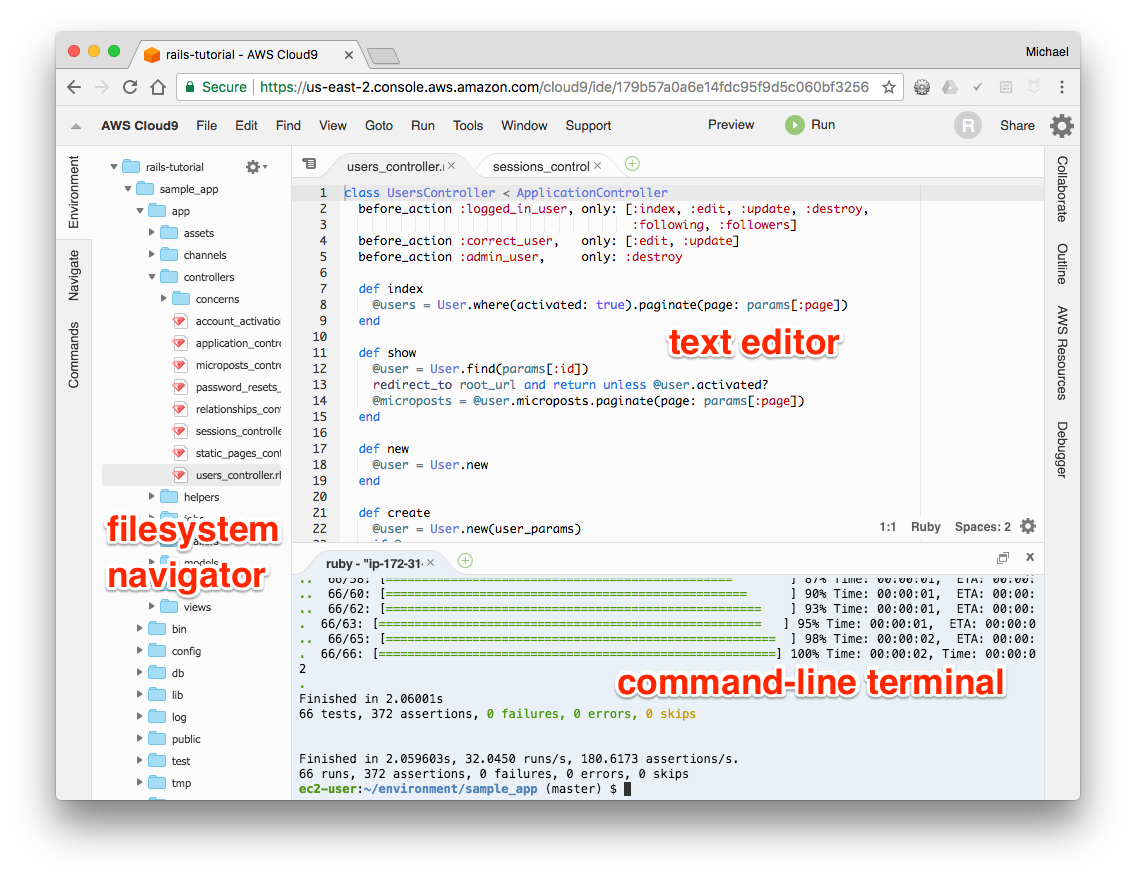
In the first chapter, you’ll get started with Ruby on Rails by installing all the necessary software and by setting up your development environment. You’ll then create your first Rails application. The Rails Tutorial emphasizes good software development practices, so immediately after creating your fresh new Rails project you’ll put it under version control with Git. And, believe it or not, in the chapter you’ll even put your first app on the wider web by deploying it to production.

Simple toy application
It might not be pretty, but it works
In Chapter 2, you’ll make a second project, whose purpose is to demonstrate the basic workings of a Rails application. To get up and running quickly, you’ll build this toy app using an automatic code generator; because this code is both ugly and complex, Chapter 2 will focus on interacting with the toy app through its URLs using a web browser.

Putting everything together
Putting all your knowledge into action
The rest of the tutorial focuses on developing a single large real sample application, writing all the code from scratch. You’ll develop the sample app using a combination of mockups, test-driven development (TDD), and integration tests. You’ll get started in Chapter 3 by creating static pages and then add a little dynamic content. You’ll take a quick detour in Chapter 4 to learn a little about the Ruby language underlying Rails. Then, in Chapter 5 through Chapter 12, you’ll complete the foundation for the sample application by making a site layout, a user data model, and a full registration and authentication system (including account activation and password resets). Finally, in Chapter 13 and Chapter 14 you’ll add microblogging and social features to make a working example site.
The result is a thorough grounding in web application development that will serve you well as a technical manager, entrepreneur, or professional software developer.


Happy people
saying nice things!

David Heinemeier Hansson Creator, Ruby On Rails
3rd edition of @mhartl's much celebrated The Ruby on Rails Tutorial is in out in draft: http://t.co/LhCMhuNEcR — looks like a great upgrade!
— DHH (@dhh) August 29, 2014

About the Ruby on Rails Tutorial
Just completed the whole tutorial, and I feel I’ve developed a new super power. Amazing book, it explains the concepts clearly and illustrates them with powerful examples, I have taken rails tutorials before, but this book gave me the basis to fully understand and be able to code in rails effortlessly.
— Mauricio Guzmán
-# NEEDS REFERENCE LINK -# NEEDS SCREENSHOT
Well, just wanted to say thank you. Best tutorial as far as I know on RoR. See you on twitter.
— Robert Hopman
-# NEEDS REFERENCE LINK -# NEEDS SCREENSHOT
My former company (CD Baby) was one of the first to loudly switch to Ruby on Rails, and then even more loudly switch back to PHP… This book by Michael Hartl came so highly recommended that I had to try it, and the Ruby on Rails Tutorial is what I used to switch back to Rails again… Though I’ve worked my way through many Rails books, this is the one that finally made me “get” it.
— Derek Sivers
– Founder, CD Baby
Just completed the whole tutorial, and I feel I’ve developed a new super power.
— Damian H.
I’ve just completed all 14 chapters of the Ruby on Rails Tutorial, and I’m very, very satisfied with the results. I’ve been a very active software engineer since the late 70’s, always staying up with current technologies, and having a ball along the way. The way I like to do tutorials is to type in every line of code myself, read the material at least twice, and do all exercises. Your tutorial has been more than worth that effort!
I’ve taken many ‘tutorials’ in the last 40 or so years, and I have come to expect that the tutorial writer ‘burns out’ somewhere around the middle of the tutorial, and it gets worse as the pages wear on. It is quite clear to me that you applied all your tools that you’ve used in preparing your physics class materials, and brought them with you to this work of yours. I am grateful for your effort, your attention to detail is simply amazingly consistent from start to finish. This tutorial has greatly aided in my transitioning from desktop / cpp to distributed apps / ruby.
Thanks to you, I feel that I have been very effectively jump-started into my role as principal engineer of my tiny new company, and hopefully will have a ball with this technology for at least another decade.
With great thanks,
— Tony Turner
Principal Engineer / Founder, White Rose Technologies, LLC

Jimmy Wales Founder, Wikipedia
Q: What is Jimmy Wales' favorite book?
A: It changes often. At the moment, it’s Ruby on Rails Tutorial by Michael Hartl. :)
Quora link

About the Learn Enough Courses
I must say, this Learn Enough series is a masterpiece of education. Thank you for this incredible work!
— Michael K.
I must say, this Learn Enough series is a masterpiece of education. Thank you for this incredible work!
— Michael K.
I want to thank you for the amazing job you have done with the tutorials. They are likely the best tutorials I have ever read.
— Pedro I.
I have been trying to learn web development and programming on and off for the past 3 years and your website is the first one that I feel does the job right.
— Janelle S.
Just bought the new ebook and want to say keep up the great work!! The Learn Enough to Be Dangerous series re-ignited my desire to code after 10+ years of “meh”.
— Diane Y.
The Learn Enough Society and the courses are incredible. It’s the best value in the market of online courses in my opinion. Like you say, it’s learning to tech, which is very useful in our world.
— Sébastien D.
I just meant to tell you: your tutorial books from the Learn Enough series are awesome! The books are well-written, clear, concise, super-useful, and even fun to read. Thank you so, so much for this! I have bought the first three and will buy whatever you publish next. Keep up doing this very good work and thanks again.
— Pierre W.
Have been following the whole “Learn Enough to Be Dangerous” series and am VERY impressed with it. I am a project manager who works with software developers daily. These sessions have provided me with a huge amount very useful information, to the extent that I now not only understand what the dev guys are talking about, but am starting to use the tools (command line, Git, etc.) that they use.
— Brian
Michael Hartl is one of the best educators around when it comes to web development. I have been following him for a long time, and everything he produces is top quality. If you are looking for a quick way to become a thorough and productive professional web developer, Hartl’s books are a great place to start.
— Abram Bailey
Hi, my name is Philip, and I’m a beginning learner of web development. I’ve dabbled in small ways in Ruby/Rails for about a year and a half. Occasionally, I write ruby scripts to solve problems at my job. I also dabble in learning: JavaScript, Ember, more Ruby/Rails, brief intro readings into Scala.
I’ve tried Codeschool, Codecademy, and I’ll stop there, so you don’t spend the next 3 hours reading all the different learning resources I’ve tried.
Ruby on Rails Tutorial (Rails 5) is undoubtedly, the most effective and educational resource I’ve ever come across when it comes to learning anything about web development or writing any code on any level.
Here’s what you seem to understand that everyone else just gets wrong: There’s a big spectrum between the very beginner basics: declaring variables, to voodoo, magical, incantational trickery of witchcraft, like building your own web server.
Almost all tutorials make this mistake. The first couple “lessons” are good for people who don’t even have a clue what computer programming is and then suddenly, there’s a big jump to what seem to be concepts that only seasoned developers have mastered.
Thanks for such a great, educational guide in Ruby on Rails.
— Philip
About the Author

Michael Hartl
Michael Hartl is the creator of the Ruby on Rails Tutorial, one of the leading introductions to web development, and is cofounder and principal author at Learn Enough. Previously, he was a physics instructor at the California Institute of Technology (Caltech), where he received a Lifetime Achievement Award for Excellence in Teaching. He is a graduate of Harvard College, has a Ph.D. in Physics from Caltech, and is an alumnus of the Y Combinator entrepreneur program.
All Access Subscription
Get free access to all 10 Learn Enough courses (including the Ruby on Rails Tutorial) for 7 days!
Free 7 Day trial details
We require a credit card for security purposes, but it will not be charged during the trial period. After 7 days, you will be enrolled automatically in the monthly All Access subscription.
BUT you can cancel any time and still get the rest of the 7 days for free!
All Learn Enough tutorials come with a 60-day 100% money-back guarantee.